Web3 and the Metaverse: How Decentralization Will Shape Virtual Worlds
Web3 and the Metaverse are redefining the digital landscape by embracing decentralization. Built on blockchain technology, these innovations empower users with true ownership of virtual assets, decentralized governance, and global economic inclusion. Dive into the technologies, benefits, and challen

The internet has always been evolving, but what's coming next feels genuinely different.
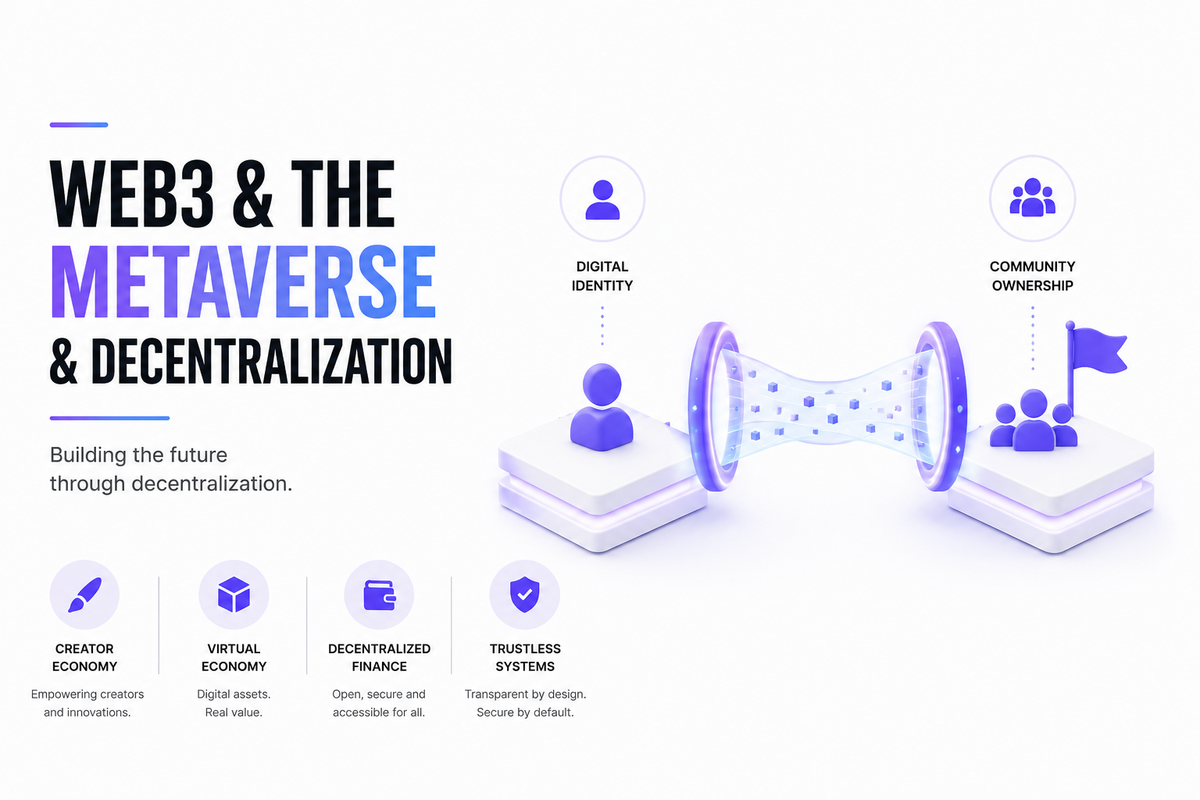
Web3 and the Metaverse are two of the most talked-about concepts in tech right now, and for good reason. Together, they represent a shift in how we think about ownership, identity, and community in digital spaces. Web3 is rebuilding the internet's infrastructure around decentralization and user control, while the Metaverse is reimagining what we can actually do online work, socialize, play, and build inside immersive virtual environments.
What connects them is a simple but powerful idea: people, not corporations, should be in control.
Understanding Web3 and the Metaverse
Web3: Taking the Internet Back
To understand Web3, it helps to know what came before it.
Web1 was the early internet with static pages you could read but not really interact with. Web2 changed that. Suddenly, the internet became social. Platforms like Facebook, YouTube, and Twitter let people create content, connect with others, and build communities. That was genuinely exciting, but it came with a catch. All of that data, content, and influence flowed through centralized platforms owned by large companies. You were the product, not the owner.
Web3 is the response to that problem. Built on blockchain technology, it shifts control back to users. Instead of a corporation holding your data on a central server, Web3 distributes that data across a network where no single entity controls it. Key features include:
- Decentralization data lives across a network, not on one company's servers
- Blockchain: a transparent, tamper-proof record of every transaction
- Smart contracts self-executing code that automatically enforce agreements without any middleman
The Metaverse: A New Kind of Digital Space
The Metaverse isn't a single app or platform; it's a network of interconnected virtual environments where people can live out digital experiences. You can socialize, work, attend events, buy property, and build things. It simulates real-world experiences in a shared digital space that's persistent, interactive, and increasingly immersive.
Early examples of Metaverse platforms already up and running include:
- Roblox a gaming platform where users build and explore virtual worlds
- The Sandbox a decentralized space where players can create, own, and monetize virtual assets
- Decentraland, where users buy, sell, and develop virtual land using cryptocurrency
These platforms are early, but they give a clear picture of where things are headed.
How Decentralization Changes Everything in Virtual Worlds
Real Ownership Not Just Access
Here's something most people don't think about: when you buy a skin in Fortnite or a piece of content on a centralized platform, you don't actually own it. The platform does. They can change the rules, shut down your account, or pull the rug out from under you at any time.
Decentralized virtual worlds flip that dynamic entirely. Using blockchain technology, users can hold genuine, verifiable ownership over their digital assets virtual land, avatars, in-game items, digital artwork represented as NFTs (non-fungible tokens). These assets are stored on the blockchain, which means they're transferable, permanent, and not subject to a company's changing terms of service.
On Decentraland or The Sandbox, for example, you can own virtual land as an NFT. You can sell it, lease it, develop it, or trade it all without asking anyone's permission.
Governance Through DAOs
In a traditional platform, the company calls all the shots. New features, policy changes, and revenue decisions: users have no real say. Decentralized Autonomous Organizations (DAOs) change that by letting users vote on the decisions that affect their communities.
In a DAO-governed Metaverse, token holders can propose and vote on everything from platform updates to land use policies. Decentraland, for instance, allows landowners to weigh in on meaningful community decisions. The Sandbox has a similar governance model where native token holders vote on development plans and partnerships.
This isn't just a nice idea; it fundamentally shifts who has power in virtual spaces. Instead of a corporate boardroom deciding the future of a platform, the community does.
Interoperability: Moving Freely Between Worlds
One of the most exciting and underappreciated features of decentralization in the Metaverse is interoperability. In centralized systems, your assets are locked to one platform. The sword you earn in one game stays in that game forever.
In a decentralized Metaverse, assets can move with you. An avatar you build on The Sandbox could, in theory, walk into Decentraland or any other platform that supports decentralized standards. Your digital identity and possessions travel across virtual worlds, giving you a unified presence in a larger, interconnected ecosystem. This creates real continuity and real value for users who invest time and money into their digital lives.
The Technologies Making It Work
Blockchain
Blockchain is the foundation everything else is built on. It functions as a distributed, transparent, and tamper-proof ledger that records every transaction and ownership change. Because no single party controls it, it's highly resistant to fraud and manipulation.
What makes blockchain particularly valuable in virtual economies is its transparency. Anyone can verify ownership or transaction history independently. And because the record is immutable once something is logged, it can't be erased or altered. Users can trust that their ownership is real and protected.
Smart Contracts
Smart contracts are essentially agreements written in code. When specific conditions are met, they execute automatically. No lawyers, no middlemen, no delays.
In the Metaverse, smart contracts handle asset transfers, property sales, and governance votes. If you buy virtual land in Decentraland, a smart contract instantly transfers the title to your wallet the moment payment clears. This removes the risk of fraud and the need for manual oversight, making transactions faster and more trustworthy.
NFTs
Non-fungible tokens are the mechanism through which ownership of unique digital assets is established. Unlike cryptocurrencies, where one Bitcoin equals any other Bitcoin, each NFT is one of a kind. It represents a specific asset: a piece of virtual land, a rare avatar, a digital painting.
NFTs aren't just collectibles. They're the backbone of decentralized digital economies. Users can buy, sell, lease, and trade NFTs across platforms, and their value is tied to genuine scarcity and verifiable ownership. In the Metaverse, NFTs give people full economic rights over their digital possessions, something that's never truly existed before in an online environment.
What Are People Actually Using This For?
Virtual Real Estate
Virtual land has become one of the most prominent use cases in the decentralized Metaverse. On platforms like Decentraland and The Sandbox, land parcels are minted as NFTs and sold on blockchain-based marketplaces. Owners can develop their properties, building businesses, hosting events, or displaying art and selling or leasing them just like physical real estate.
This isn't just speculative. Virtual land has real economic value because it comes with real rights and real opportunities to monetize. The decentralized structure ensures that ownership is genuine and that no central authority can take it away.
Digital Identity and Avatars
In a decentralized Metaverse, your avatar is truly yours. Built using NFTs and blockchain-based identity tools, your digital self can move across platforms while staying consistent. Unlike a profile on Facebook or a character in a game you don't control, a blockchain-based identity belongs to you, and you decide how much information to share, where to take it, and how to represent yourself.
This matters for privacy and security. Decentralized identities give users autonomy over their online personas in a way that centralized platforms simply don't allow.
Play-to-Earn and Economic Opportunity
One of the more transformative aspects of the decentralized Metaverse is the ability to earn real-world value through participation. In blockchain-based games like Axie Infinity, players can earn cryptocurrency by completing tasks or engaging in battles. That crypto can be exchanged for real currency, meaning time spent in the Metaverse has tangible financial value.
Beyond gaming, users can create and sell digital goods, clothing, art, and tools using NFTs to establish ownership and value. For creators, developers, and entrepreneurs, the decentralized Metaverse represents a genuinely new economic frontier. And because participation only requires an internet connection, it opens wealth-building opportunities to people who might otherwise be shut out of traditional markets.
The Honest Truth: Benefits and Real Challenges
What Makes This Exciting
- True Ownership and Control Your digital assets are verifiably yours, protected by the blockchain, and not subject to a company's whims.
- Community Governance DAOs give users actual power over the platforms they use, making virtual worlds more democratic and responsive.
- Economic Inclusion Anyone with internet access can participate in decentralized economies, earn income, and build wealth regardless of location or financial background.
What Still Needs to Be Figured Out
- Scalability — Blockchain networks, particularly Ethereum, still struggle with congestion. High transaction volumes can drive up gas fees and slow processing times. Solutions like layer-2 networks and alternative blockchains (Solana, Polygon) are helping, but this remains an active challenge.
- Security — Smart contracts are only as good as the code behind them. Bugs and vulnerabilities can be exploited by hackers, leading to significant financial losses. The DeFi space has seen its share of high-profile breaches, and the Metaverse is not immune.
- Regulation — Governments are still working out how to handle virtual economies. Questions around asset ownership, taxation, intellectual property, and governance are largely unresolved. That uncertainty creates risk for both users and developers.
What Comes Next
Mass Adoption on the Horizon
Augmented reality (AR) and virtual reality (VR) are going to be game-changers for Metaverse adoption. As headsets become more affordable and the technology improves, immersive virtual environments will feel less like a novelty and more like a natural extension of everyday life. This will bring decentralized platforms to a much wider audience: people who might not care about blockchain at all but who will benefit from the ownership and freedom it provides.
Reshaping Business and Society
The implications of a decentralized Metaverse stretch well beyond gaming and entertainment. Remote work, digital commerce, and social interaction are all ripe for transformation. Decentralized virtual offices, peer-to-peer marketplaces, and community-governed platforms could fundamentally change how businesses operate and how people collaborate across borders. The shift won't happen overnight, but the direction is clear.
Brands Are Already Moving In
Major brands aren't sitting on the sidelines. Gucci and Adidas have already launched branded virtual experiences on platforms like Decentraland and The Sandbox. These aren't just marketing stunts; they represent a genuine bet on where consumer attention and spending are heading. As more companies build presences in decentralized virtual worlds, the Metaverse will increasingly look like a legitimate extension of the mainstream economy.
Final Thoughts
Decentralization isn't just a technical feature of Web3 and the Metaverse; it's the philosophical backbone of both. It's about returning control to individuals: control over their data, their assets, their identities, and the communities they're part of.
The tools are already here: blockchain, smart contracts, NFTs, and DAOs, and they're getting better fast. The decentralized Metaverse is still early, but the foundations are being laid right now. For anyone who wants to understand where the internet is going and who wants to be part of shaping it, there's no better time to start paying attention.