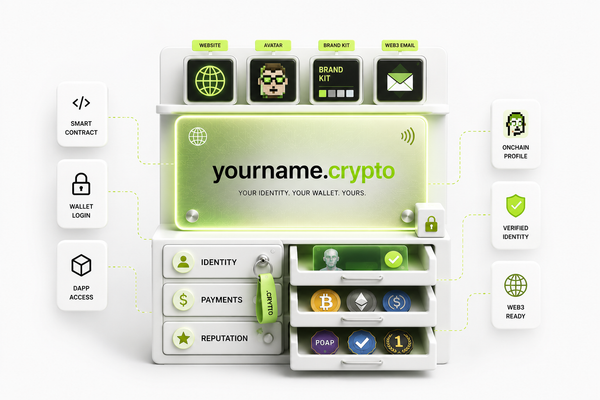
The Expanding Ecosystem of Web3 TLDs: From .eth to .dao: What’s Next?
Web3 TLDs are revolutionizing digital identity and ownership by enabling decentralized, blockchain-based solutions. From .eth to .nft, these domains offer enhanced security, cross-chain compatibility, and censorship resistance, paving the way for a user-driven, decentralized internet.
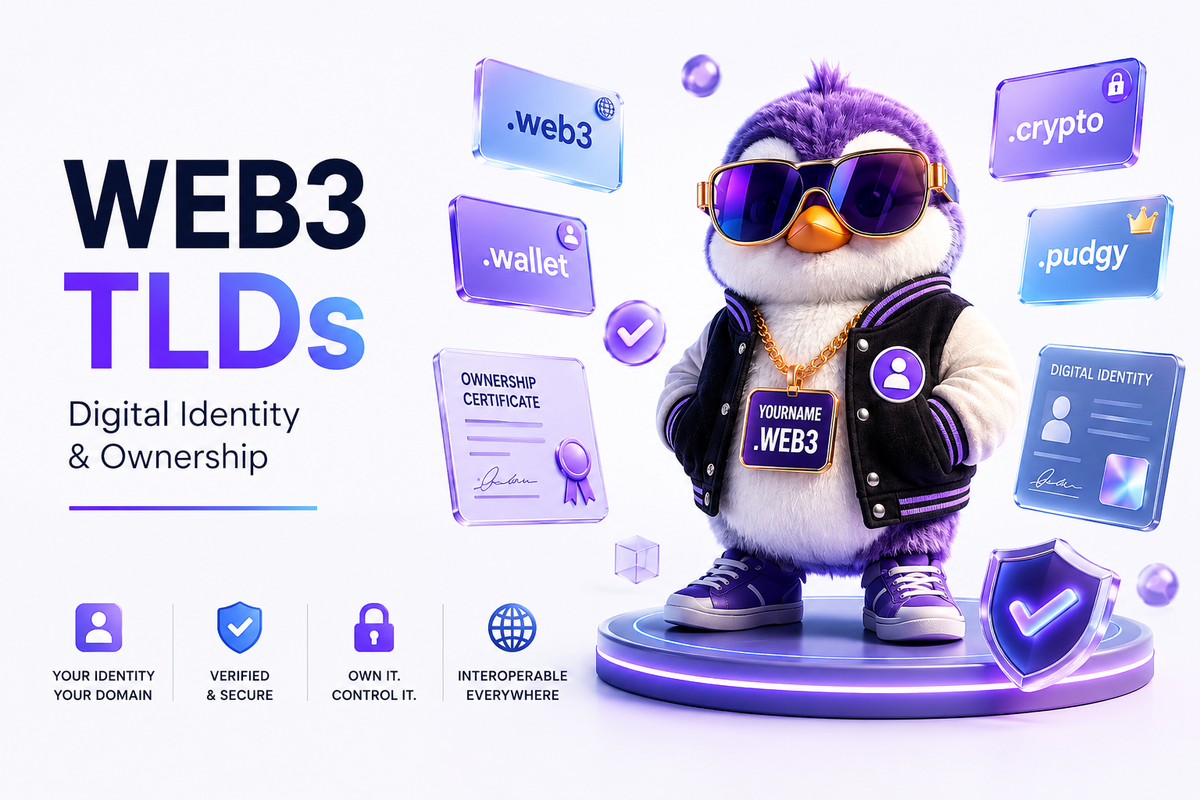
Think about what a blockchain domain name really is. On the surface, it's just a web address, a string of characters that points people to your corner of the internet. But dig a little deeper, and it's something more fundamental than that. It's your identity online. It's how people find you, trust you, and remember you.
For decades, that identity has been rented, not owned. Your .com or .org domain exists because a centralized authority, namely ICANN, and a chain of registrars allow it to. Pay your annual fee, stay within the rules, and you're fine. But the moment you stop paying, or the moment someone decides your domain violates a policy, it can be taken away. You never truly owned it.
Web3 is changing that fundamentally and permanently.
Web3 Top-Level Domains (TLDs) like .eth, .crypto, and .dao are a new class of domain names built directly on blockchain networks. They can't be revoked by a registrar. They can't be censored by a centralized authority. Once you own one, it's yours stored on the blockchain, controlled by your private key, and answerable to no one but you.
This blog breaks down what Web3 TLDs are, where they came from, where they're headed, and why they matter for anyone building a presence in the decentralized web.
What Are Web3 TLDs and How Are They Different?
The Basics
A Web3 top-level domain is a domain name that lives on a blockchain rather than on a centralized server managed by a traditional registrar. Instead of ICANN overseeing who owns what, ownership is recorded directly on a public blockchain, transparent, immutable, and entirely in the hands of the domain holder.
The most well-known examples include .eth (on the Ethereum blockchain, managed by the Ethereum Name Service), .crypto (offered by Unstoppable Domains), and .zil (on the Zilliqa blockchain). Each of these operates on the same core principle: your domain is a digital asset you own outright, not a service you're subscribing to.
Decentralization and What It Actually Means for You
In a traditional domain system, your domain can be suspended, seized, or transferred without your consent if the registrar or a government authority decides to act on it. That's not a hypothetical; it happens regularly to websites in politically sensitive spaces or industries that fall out of regulatory favor.
With a Web3 TLD, that dynamic doesn't exist. The domain lives on a decentralized blockchain network, verified by thousands of nodes rather than a single authority. No registrar can pull the plug. No government can simply order a takedown. The domain holder, and only the domain holder, controls what happens to it.
Beyond censorship resistance, Web3 domains connect directly to cryptocurrency wallets, DeFi platforms, and decentralized applications. They're not just addresses; they're functional tools for operating in the decentralized ecosystem.
Web3 Domains as Digital Identity
Perhaps the most significant shift Web3 TLDs represent is the move toward self-sovereign identity. In the traditional web, your identity is fragmented across platforms: your Google account, your Twitter handle, and your bank login. Each one is owned and managed by a different company, and none of them are truly yours.
Web3 domains consolidate that. A single .eth or .crypto domain can serve as your verified identity across wallets, dApps, NFT marketplaces, and DeFi platforms. It's a unified, portable, blockchain-anchored identity that you control and that travels with you across the entire decentralized web.
The Domain That Started It All: .eth
How ENS Changed the Game
The Ethereum Name Service (ENS) launched the .eth TLD as one of the first practical demonstrations of what decentralized domain ownership could look like. Before ENS, interacting with Ethereum meant dealing with wallet addresses that looked like this: 0x4bE...7f2a. Long, impossible to memorize, and easy to mistype.
ENS replaced that with something human-readable. Instead of copying and pasting a 42-character string, you could just share "yourname.eth." Simple, clean, and far less likely to result in a costly error.
What Makes .eth Domains Worth Having
The functionality goes well beyond aesthetics. .eth domains are owned through smart contracts on the Ethereum blockchain, which means ownership is secured by code rather than a corporate terms-of-service agreement. There's no annual renewal fee paid to a registrar who can decide not to renew your domain. There's no third party that can intervene.
Key uses for .eth domains include:
- Crypto payments link your. eth domain to your Ethereum wallet so people can send you funds using a name instead of a wallet address
- Cross-platform identity Use your .eth domain as a verified identity across dApps, NFT platforms, and DeFi services
- NFT portfolios Present your collections and digital creations under a recognized, trustworthy digital identity that collectors and buyers can verify
The Broader Impact
The launch of .eth didn't just make Ethereum easier to use; it opened the door to a whole new way of thinking about domain names. By proving that a decentralized domain system could work at scale, ENS set the template for everything that followed. It demonstrated that blockchain-based identity wasn't just a theoretical concept; it was something people could register, use, and genuinely own.
The Expanding Universe: .crypto, .zil, and Beyond
.crypto: Your Identity Across Every Blockchain
Offered by Unstoppable Domains, .crypto is one of the most versatile Web3 TLDs available. Its standout feature is cross-chain compatibility, meaning a single .crypto domain can be connected to wallet addresses across multiple blockchain networks simultaneously. Bitcoin, Ethereum, Solana, and others can all be linked to one readable address.
For users who operate across multiple chains, which is increasingly common as the blockchain space matures, this is a significant quality-of-life improvement. Instead of managing a different address for every network, you have one unified identity that works everywhere.
There's also an important ownership distinction with .crypto domains: Unstoppable Domains operates on a one-time purchase model. You buy the domain once and own it forever no annual renewal, no risk of losing it because you forgot to pay a fee.
.zil: Decentralized Hosting on Zilliqa
.zil domains run on the Zilliqa blockchain and are particularly notable for their decentralized web hosting capabilities. By pairing .zil domains with IPFS (the InterPlanetary File System), users can host entire websites on a decentralized network with no traditional hosting provider required.
What that means in practice is a website that can't be taken down by a hosting company, can't be blocked by a single point of failure, and remains accessible even if the original server goes offline. For content creators, journalists, or anyone operating in environments where censorship is a genuine risk, that level of resilience is genuinely valuable.
.zil domains also function as digital identities across Zilliqa-based dApps and can be linked to cryptocurrency wallets, making them a comprehensive tool for participating in that ecosystem.
The Bigger Picture
Both .crypto and .zil represent the same underlying shift: ownership moving from centralized registrars to individual users. As these domains become more widely adopted, they're laying the infrastructure for a more open, more resilient, and more user-controlled internet one where decentralized commerce, secure identity management, and censorship-resistant content hosting are the norm rather than the exception.
The Next Wave: .dao, .nft, and Niche Web3 TLDs
.dao: Infrastructure for Decentralized Organizations
Decentralized Autonomous Organizations DAOs are one of the most interesting experiments in collective governance that blockchain has enabled. A DAO is an organization governed by code and community vote rather than executives and corporate hierarchy. Members propose changes, vote on decisions, and collectively shape the organization's direction, all recorded transparently on the blockchain.
.dao domains give these organizations a decentralized digital identity to match their decentralized structure. Rather than pointing to a traditional website hosted on a centralized server, a .dao domain connects directly to governance platforms, community hubs, and official communications channels. It gives members and outside observers a verifiable way to confirm they're engaging with the legitimate organization, not an imitation.
As DAOs become more prominent in DeFi, NFTs, and community-led projects, .dao domains will become increasingly important infrastructure for how these organizations operate and present themselves.
.nft: A Home for the Creator Economy
The NFT space has fundamentally changed what it means to own digital art, music, and collectibles. .nft domains are built to serve that ecosystem, giving creators, collectors, and platforms a decentralized space to build portfolios, manage communities, and facilitate peer-to-peer transactions.
An artist with a .nft domain can host their entire portfolio there, connect their wallet for direct sales, and build a verified digital identity that follows them across NFT marketplaces and Web3 platforms. Collectors can use .nft domains to organize and showcase their holdings. Platforms can build decentralized marketplaces anchored to a recognizable and trustworthy domain identity.
As the creator economy continues to grow and as more creators look for ways to own their relationship with their audience rather than depending on centralized platforms .nft domains offer a compelling foundation.
Other Niche TLDs Worth Watching
The Web3 domain space is expanding into increasingly specialized territory:
- .btc Tailored for Bitcoin users who want a human-readable identity tied to the most established cryptocurrency
- .defi Designed for projects and users operating within the decentralized finance ecosystem
- .x A cross-chain option for services and applications that operate across multiple blockchain networks
Each of these serves a specific segment of the Web3 ecosystem, providing naming infrastructure that matches the identity and purpose of the users and projects that adopt them.
Where Web3 TLDs Are Headed
Cross-Chain Interoperability as the Next Frontier
Right now, different Web3 TLDs tend to live on specific blockchains. .eth is Ethereum. .zil is Zilliqa. That works well enough when users are focused on a single ecosystem, but the reality of Web3 is that most active users operate across multiple chains simultaneously.
The future of Web3 TLDs almost certainly involves deeper cross-chain interoperability domains that work seamlessly across all major blockchain networks without requiring users to manage separate identities on each one. As that infrastructure matures, a single Web3 domains could serve as your universal identifier across every blockchain you interact with, regardless of the underlying network.
Domain-as-Identity: The Full Picture
The trajectory of Web3 TLDs points toward something bigger than just domain names; it points toward a comprehensive identity layer for the decentralized internet. Your Web3 domain could eventually anchor your verifiable credentials, your ownership records, your transaction history, your reputation across platforms, and your participation in decentralized governance all in one place, all under your control.
That's a meaningful shift from how identity works today, where your data is fragmented across dozens of platforms, each of which owns a piece of you.
Integration with Broader Web3 Infrastructure
Future Web3 TLDs are likely to integrate more deeply with decentralized protocols like IPFS for hosting, decentralized social media platforms, and blockchain-based identity verification systems. The more these domains connect to the broader Web3 ecosystem, the more functional and valuable they become, and the harder it becomes to justify using traditional domain systems for Web3-native projects.
The Honest Challenges
Web3 TLDs have real advantages, but they're not without friction, and it's worth being clear-eyed about the challenges.
Technical complexity is the biggest barrier to mainstream adoption right now. Most people who use the internet are comfortable with .com domains and have no idea what a private key is. The process of registering, managing, and securing a Web3 domain is more involved than buying a traditional domain through GoDaddy or Namecheap. Better user interfaces and more accessible educational resources will be essential for closing that gap.
Security risks haven't disappeared just because domains are decentralized. If you lose your private key, you lose access to your domain, and there's no customer support line to call. Phishing attacks are also a growing concern, where bad actors create similar-looking Web3 domains to deceive users into thinking they're interacting with a legitimate organization. Awareness and proper key management practices are critical.
Regulatory uncertainty is a real factor as well. Governments are still working out how to treat blockchain-based assets, and Web3 domains will inevitably be part of that conversation. The legal status of domain ownership on the blockchain isn't fully established in most jurisdictions, which creates some uncertainty for businesses and individuals who want to rely on these domains for serious commercial activity.
None of these challenges are insurmountable they're the kinds of growing pains that come with any genuinely new technology. But they're worth understanding before diving in.
Why This Matters for Everyone Not Just Crypto Enthusiasts
It's easy to look at Web3 TLDs and assume they're primarily relevant to blockchain developers, DeFi traders, and NFT collectors. And right now, that's largely true; early adoption tends to concentrate among technical users.
But the underlying value proposition extends much further. Anyone who cares about owning their online presence rather than renting it from a corporation has a reason to pay attention. Journalists operating in environments with censorship risk. Creators who are tired of having platforms control their relationship with their audience. Businesses that want a verifiable, tamper-proof digital identity. Organizations that want to operate transparently and collectively without a traditional corporate structure.
As the user experience improves and awareness grows, Web3 TLDs will become increasingly relevant to mainstream users who may not even know what a blockchain is but who care very much about controlling their own digital lives.
Final Thoughts
Web3 TLDs represent a genuine shift in how digital identity and online presence work. They move ownership from centralized registrars to individual users. They enable censorship-resistant websites and communication. They provide the foundation for self-sovereign identity in a decentralized ecosystem.
The space is still early. The technology is still maturing. The challenges are real. But the direction is clear: the internet is moving toward user ownership, and domain names are one of the most fundamental places where that shift is happening.
Whether you're a developer building in Web3, a creator looking to own your digital presence, or a business exploring what decentralized identity could mean for your operations, Web3 TLDs are infrastructure worth understanding now, before they become the standard that everyone else is catching up to.
Your domain name is your identity online. In Web3, it's finally yours to keep.