Tokenomics 101: Understanding the Economics of Web3 Tokens and Cryptocurrencies
Tokenomics: Decoding Web3's digital economy. Explore the essential principles behind cryptocurrency and token valuation, from supply and demand to governance and security.

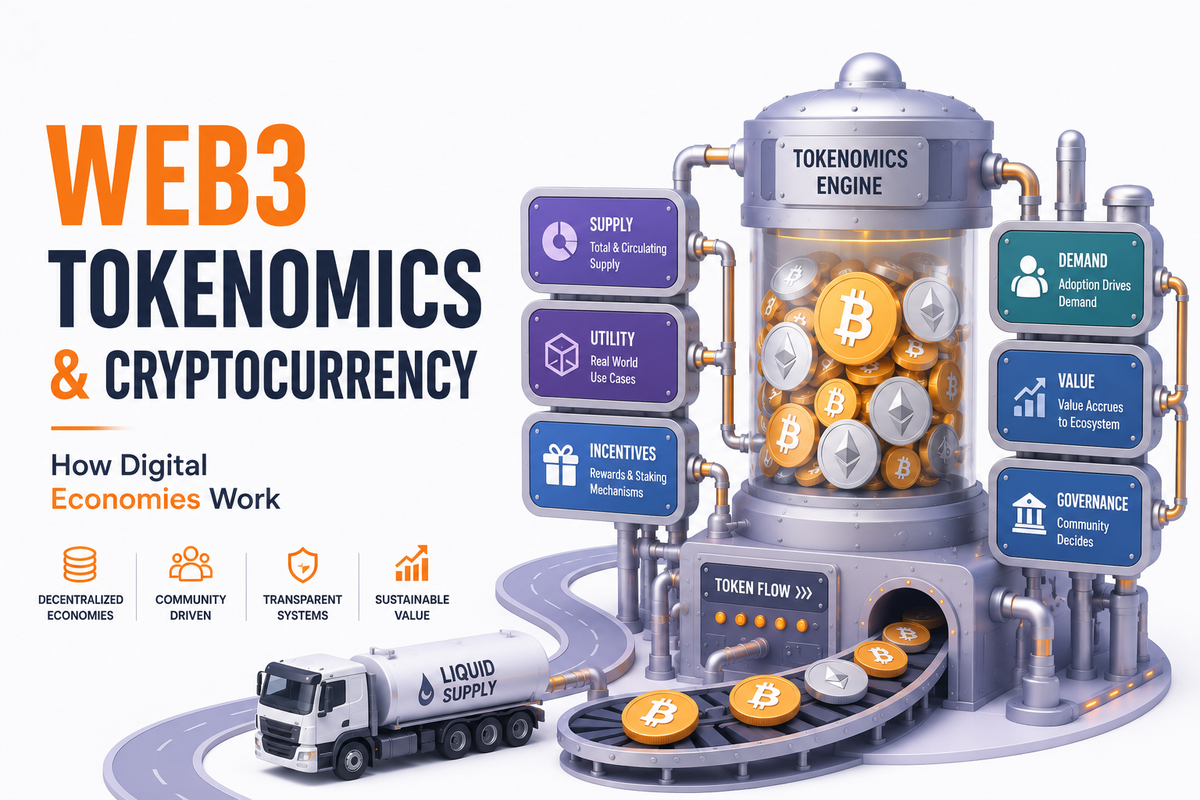
Every functioning economy runs on rules. Rules about how money is created, how it's distributed, what it can be used for, and what determines its value. Traditional economics has centuries of theory and practice behind it. The digital economy being built on blockchain technology is newer, faster-moving, and in some ways more complex, but it runs on rules too.
Those rules are called tokenomics.
If you've spent any time in the cryptocurrency or Web3 space, you've probably encountered the term without getting a clear explanation of what it actually means. This guide changes that. Whether you're an investor trying to evaluate a new project, a developer building on blockchain infrastructure, or simply someone trying to understand where digital finance is heading, understanding tokenomics is one of the most valuable things you can do.
What Tokenomics Actually Means
The word combines "token" and "economics," which gives you a reasonably accurate first impression. Tokenomics is the study of the economic principles and models that govern digital tokens within blockchain ecosystems. It covers how tokens are created, how they're distributed, how their supply is managed over time, and how all of those factors influence their value and utility.
Think of it as the economic constitution of a blockchain project. Just as a country's monetary policy defines how its currency works, a project's tokenomics defines the rules by which its digital tokens operate. Those rules determine whether the token has genuine utility, whether its supply mechanics encourage long-term holding or short-term speculation, and whether the overall economic design supports the project's goals or works against them.
To fully understand tokenomics, it helps to recognize that not all tokens serve the same purpose. The space includes several distinct categories, each with different functions and different economic implications.
Cryptocurrencies like Bitcoin and Ethereum function as digital currencies, serving as a store of value, medium of exchange, or unit of account. They're the closest equivalent to traditional money in the blockchain world.
Utility tokens provide access to specific products or services within a particular ecosystem. They're not primarily investments. They're functional tools that let you use a platform or dApp, pay for transactions within a network, or access features that require token ownership.
Security tokens represent ownership or financial rights in an underlying asset, similar to stocks or bonds in traditional finance. They're subject to regulatory frameworks and are typically used for capital raising, with investors potentially receiving dividends or profit-sharing.
Governance tokens give holders voting rights over decisions within a decentralized platform or protocol. In DeFi protocols and DAOs, governance token holders vote on upgrades, fee changes, partnerships, and other proposals that shape how the platform evolves.
Stablecoins are designed to maintain a stable value, usually pegged to a fiat currency like the US dollar. They combine the transaction efficiency of cryptocurrency with price stability, making them practical for everyday use cases where volatility would be a problem.
Understanding these distinctions is the first step toward understanding why tokenomics matters. Different token types require different economic designs, and evaluating a project intelligently means understanding which type of token you're dealing with and whether its tokenomics support its stated purpose.
The Key Components of Tokenomics
Token Supply
Supply mechanics are probably the most fundamental element of tokenomics, and they're worth understanding in some detail because they directly affect value.
Total supply refers to the total number of tokens that will ever exist for a given asset, including both tokens currently in circulation and those that are locked, reserved, or not yet distributed.
Circulating supply is the number of tokens currently available in the market. This is the number that matters most for calculating market capitalization, which is simply the circulating supply multiplied by the current price. Two tokens with identical prices but different circulating supplies have very different market caps and very different economic profiles.
Maximum supply is the hard cap on how many tokens can ever be created. Bitcoin's maximum supply of 21 million coins is the most famous example. This hard limit is a deliberate design choice that creates scarcity, which in turn creates upward pressure on price as demand grows against a fixed supply ceiling.
Minting and burning are the mechanisms through which supply changes over time. Minting creates new tokens, either continuously as with inflationary models or at defined intervals. Burning permanently removes tokens from circulation, reducing the total supply and potentially increasing the value of remaining tokens. Projects use burning strategically to manage inflation, create scarcity, and support price stability.
Token Distribution
How tokens are distributed at launch and over time has enormous implications for a project's fairness, stability, and long-term viability.
Token vesting locks a portion of tokens allocated to team members, advisors, and early investors for a predetermined period. This is a protective mechanism designed to prevent large holders from immediately selling their tokens after a launch, which could crash the price and damage the project's credibility. Vesting schedules that extend over one to four years are common in well-designed projects.
Initial Coin Offerings (ICOs) were the dominant early fundraising mechanism for blockchain projects, allowing startups to sell a portion of their tokens to the public in exchange for established cryptocurrencies or fiat money. ICOs enabled direct public fundraising but also became associated with significant fraud and regulatory scrutiny.
Security Token Offerings (STOs) represent a more regulated approach, with token sales structured to comply with securities laws and offering investors rights similar to those associated with traditional financial instruments. They provide more investor protection but also more regulatory overhead.
Airdrops distribute free tokens to users, typically to reward early adopters, incentivize new user acquisition, or generate community engagement around a new project. A well-executed airdrop can build a broad, engaged token holder base quickly.
Token Utility
A token's utility, what it actually does and what problems it solves, is arguably the most important determinant of its long-term value. Tokens without genuine utility are essentially speculative instruments, and their prices tend to reflect sentiment rather than fundamentals.
Governance is one of the most common utility functions, giving holders the ability to vote on protocol decisions and shape the direction of the platform. Staking allows token holders to lock their tokens in the network to earn rewards while contributing to network security. Payments using tokens as the native currency within an ecosystem create ongoing demand from users who need the token to access services. Access rights permit token holders to use specific features, content, or services that require token ownership.
In decentralized applications, utility tokens serve all of these functions simultaneously, creating multiple sources of demand that support the token's value beyond pure speculation.
What Determines a Token's Value
Token value doesn't emerge from nowhere. It's determined by a combination of factors that interact in complex ways, and understanding them helps you evaluate whether a token's current price reflects genuine fundamentals or speculative excess.
Demand is the most immediate driver of price. When more people want a token for its utility, its investment potential, or its network effects, the price rises. Network effects matter particularly in this context: a platform that becomes more valuable as more people use it creates growing demand for its native token as adoption increases.
Supply interacts with demand to set the price. A token with a limited maximum supply, like Bitcoin, experiences naturally increasing scarcity as more of the available supply is held long-term. Tokens with high inflation rates, where new tokens are created faster than demand grows, face persistent downward price pressure.
Utility supports price in ways that pure speculation doesn't. A token that people genuinely need to use a valuable service has structural demand that exists independently of market sentiment. This is why tokens with strong real-world utility tend to be more stable investments than purely speculative assets.
Speculation is an honest part of the picture that's worth acknowledging directly. A significant portion of cryptocurrency price movement reflects traders' expectations about future price rather than current utility or fundamentals. This creates volatility, and it means that even well-designed tokens can experience dramatic price swings that have nothing to do with the quality of the underlying project.
Market sentiment amplifies these effects. Positive news about partnerships, technology upgrades, or regulatory clarity tends to boost prices. Negative news about security breaches, regulatory crackdowns, or team problems tends to cause sharp declines. Social media, influencer commentary, and community opinion all feed into sentiment in ways that can move prices significantly in the short term.
Token velocity is a less commonly discussed but genuinely important concept. It refers to how frequently tokens change hands within the ecosystem. Very high velocity, where tokens are constantly traded rather than held, can dilute value by indicating that tokens aren't being accumulated for long-term holding. Very low velocity can indicate poor liquidity and limited practical utility. The sweet spot depends on the token's design and purpose.
Economic Models in Tokenomics
Inflationary vs. Deflationary Models
Inflationary tokenomics involves a supply that grows over time, typically through mining or staking rewards. The logic behind inflation is that it keeps tokens circulating by discouraging hoarding, rewards network participants actively, and maintains liquidity. Dogecoin and pre-merge Ethereum are examples of tokens with inflationary designs. The risk is that if new supply grows faster than demand, the token's value erodes over time.
Deflationary tokenomics works in the opposite direction, reducing the circulating supply over time through mechanisms like token burning or hard supply caps. The logic is that growing scarcity drives value appreciation as demand stays constant or grows against a shrinking supply. Bitcoin and Binance Coin are examples. The risk is that deflation can reduce liquidity and discourage the kind of active token circulation that makes an ecosystem function efficiently.
Most well-designed token economies sit somewhere between these extremes, using a combination of mechanisms to balance inflation and deflation in ways that serve the specific needs of their ecosystems.
Staking and Yield Farming
Staking in Proof of Stake systems involves locking tokens in a network to help validate transactions. In return, stakers earn rewards, typically in the form of additional tokens. This design serves two purposes simultaneously: it secures the network by giving validators a financial stake in its integrity, and it gives token holders a way to earn passive income without selling their holdings.
Yield farming takes a similar concept into DeFi liquidity provision. Users deposit tokens into liquidity pools that DeFi platforms use for trading, lending, and other financial services. In return, liquidity providers receive yield in the form of interest or additional tokens. Yield farming has been one of the primary mechanisms driving DeFi adoption by giving participants a concrete financial incentive to provide the liquidity that makes DeFi markets function.
Governance Models
Governance tokens give holders direct influence over a platform's future through on-chain voting. Token holders can propose and vote on protocol upgrades, fee structures, treasury allocations, and partnership decisions. This model decentralizes control in a meaningful way, putting consequential decisions in the hands of the community rather than a central team.
DAOs formalize this governance model into organizational structures run entirely by code on the blockchain. Decisions happen through proposals that governance token holders vote on, with outcomes automatically implemented through smart contracts. The result is a transparent, democratic decision-making process where every token holder's vote counts and the outcomes are publicly verifiable.
The Challenges Worth Understanding
Tokenomics is genuinely promising as a framework for organizing digital economies, but it comes with challenges that anyone operating in this space needs to take seriously.
Regulatory complexity is the most immediately practical challenge. Different countries classify and regulate tokens differently, and those classifications have significant implications for how projects can operate, raise funds, and serve users globally. A project that's fully compliant in one jurisdiction may face serious legal exposure in another. The regulatory landscape is evolving quickly, and projects that build compliance infrastructure proactively are better positioned than those that treat regulation as someone else's problem.
Price volatility affects token utility in ways that tokenomics design alone can't always solve. Tokens that fluctuate dramatically in value are unreliable for everyday use, which reduces their practical utility and can drive users toward stablecoins for actual transactions. Managing volatility through thoughtful supply mechanics and genuine utility development is one of the central challenges of token design.
Smart contract security is the technical challenge that underlies all of the others. Smart contracts are the foundation of token functionality in most blockchain ecosystems, and their vulnerabilities are the most exploited attack surface in the space. Bugs in contract code, logic errors, and deliberately introduced exploits have resulted in billions of dollars of losses. Rigorous auditing, formal verification, and ongoing security monitoring are essential for any project that takes its tokenomics seriously.
Why Understanding Tokenomics Matters
Whether you're evaluating a token as an investment, building a project that needs a sound economic foundation, or simply trying to understand the space, tokenomics gives you the framework to ask the right questions.
What is the maximum supply, and how is new supply created? Who holds the tokens, and what are their vesting schedules? What genuine utility does the token provide, and is that utility reflected in sustainable demand? What economic model governs the token's supply over time, and does that model support the project's long-term goals? How are governance decisions made, and do token holders have real influence?
These questions don't guarantee good investments or successful projects, but they create a much more solid basis for evaluation than price charts and social media sentiment alone. In a space that moves as fast as Web3, that kind of analytical foundation is genuinely valuable.