10 Reasons to Buy Web3 Domains
The rise of Web3 signifies a shift towards decentralized online experiences, where Web3 aggregators play a crucial role.

The internet doesn't sit still. Every few years, something comes along that fundamentally changes how we communicate, do business, and build an online presence. Web3 is that something and at the heart of it are Web3 domains.
If you've been hearing the term thrown around and aren't quite sure what it means or whether it applies to you, you're in the right place. Let's start from the beginning.
So, What Exactly Is a Web3 Domain?
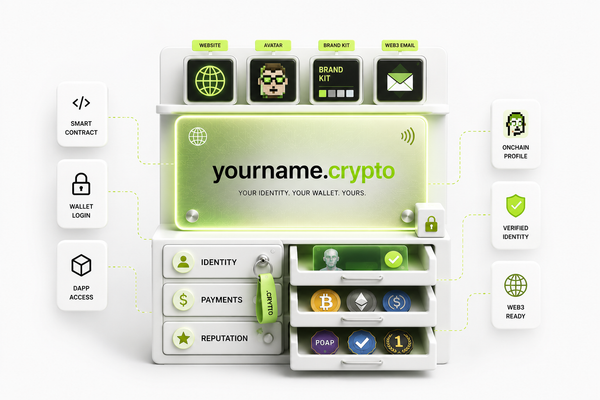
A Web3 domain also called an NFT domain is a new kind of internet address built on blockchain technology and smart contracts. On the surface, it works similarly to the traditional domain name system (DNS) you already know. But underneath, it operates very differently.
Traditional domains are rented. You pay a registrar like GoDaddy or Namecheap every year to use a name, and they retain ultimate control over it. Web3 domains, by contrast, are owned. Once you register one, it's yours stored in your crypto wallet like any other digital asset, governed by a smart contract, and free from centralized control.
These domains serve as the building blocks of the decentralized web. They power decentralized applications (dApps), support decentralized autonomous organizations (DAOs), connect to DeFi platforms, and give NFT projects a home. More practically, they make all of that technology more accessible by replacing complex blockchain addresses with simple, human-readable names that people can actually remember.
Why Does This Matter Right Now?
We're at an inflection point. The shift from Web2 the centralized, platform-dominated internet most of us grew up with to Web3 is well underway. Blockchain technology is moving from niche to mainstream, and the infrastructure supporting it is maturing fast.
Web3 domains sit at the intersection of that infrastructure and everyday usability. They make decentralized technology approachable for regular users, and they give businesses and creators a stake in the next version of the internet. Getting in early isn't just smart it's strategic.
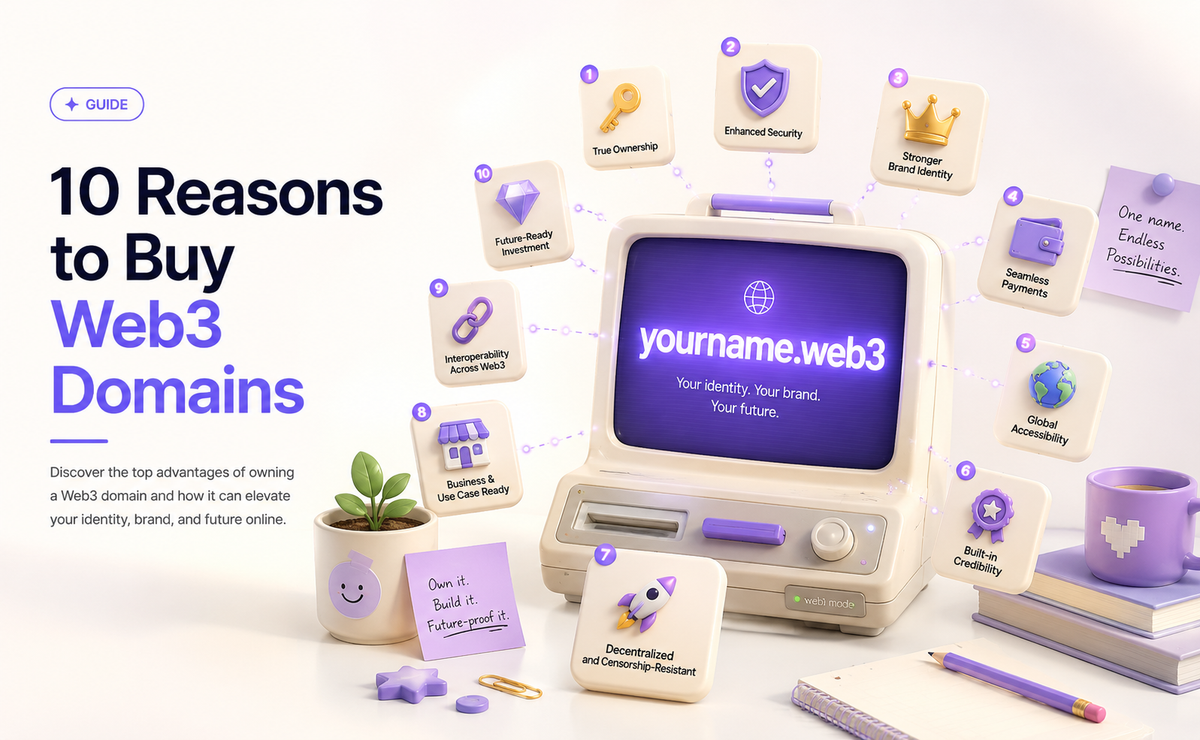
Here are ten concrete reasons why.
1. Security That's Built Different
Traditional domains are stored on centralized servers which means they have a single point of failure. If that server is compromised, so is your domain. Hackers, bad actors, and even negligent registrars have all caused real harm to businesses operating under the old model.
Web3 domains take a fundamentally different approach. Instead of storing data on one central server, they distribute it across a network of nodes. There's no single target for a cybercriminal to attack. On top of that, every transaction on a Web3 domain is recorded on a blockchain a cryptographically linked, tamper-proof ledger that makes unauthorized changes virtually impossible.
For anyone running a business online, that's not a minor upgrade. It's a completely different security posture.
2. Flexibility That Traditional Domains Can't Match
One of the quiet frustrations of traditional domains is how rigid they are. You get a name, you point it somewhere, and your options mostly end there.
Web3 domains are far more flexible. You can create subdomains that function as entirely separate websites useful if you're running multiple products, services, or marketing campaigns under one brand. You can embed smart contracts directly into your domain infrastructure, automating things like payments, access permissions, or content delivery without any manual intervention.
That kind of built-in programmability is genuinely new. It turns your domain from a passive address into an active piece of business infrastructure.
3. Real Ownership Not Just a License
This is one of the most important differences between Web2 and Web3 domains, and it doesn't get talked about enough.
When you register a traditional domain, you don't own it you license it. The registrar can suspend it. The governing body can revoke it. In some cases, legal disputes can strip it from you entirely. You're always operating at someone else's discretion.
With a Web3 domain, that dynamic flips. The domain is registered on the blockchain, ownership is tied to your wallet, and no centralized entity can take it from you. You can sell it, transfer it, hold it as a long-term asset, or build on it all on your own terms.
4. Privacy That's Actually Private
Register a traditional domain and your personal details name, address, contact information get logged in the WHOIS directory. Yes, there are privacy protection services that mask this, but they come at an extra cost and are still managed by a third party.
Web3 domains handle privacy differently from the ground up. Your personal information isn't tied to the domain in any public-facing way. There's no WHOIS equivalent exposing your details to anyone who bothers to look. For businesses handling sensitive data financial services, healthcare, legal this isn't just a preference. It's a practical necessity.
5. You're Making a Future-Proof Investment
Here's a perspective worth sitting with: the businesses that bought .com domains in the early 1990s, before most people understood what the internet would become, made out extraordinarily well. Web3 domains represent a similar moment.
Decentralized finance, NFTs, DAOs, and the broader Web3 ecosystem aren't going away. They're gaining momentum, attracting institutional investment, and becoming increasingly integrated into mainstream commerce and culture. A Web3 domain isn't just a technical asset it's a stake in that future.
Early adopters get the best names, the lowest prices, and the deepest understanding of an ecosystem that's still taking shape. That combination tends to pay off.
6. No Central Authority Pulling the Strings
One of the foundational promises of Web3 is that no single entity controls the network. Web3 domains are built on that principle.
Traditional domain infrastructure is surprisingly fragile from a control standpoint. Registrars can be pressured by governments, targeted by hackers, or simply go out of business and your domain goes with them. Web3 domains distribute control across a decentralized network of nodes, which means there's no single authority to pressure, hack, or shut down.
This matters especially for businesses operating in politically sensitive environments or industries where censorship is a real risk. Decentralized control isn't just a philosophical stance it's practical resilience.
7. Global Accessibility Without the Red Tape
Traditional domains can come with surprising geographic headaches. Certain extensions are restricted to specific countries. Regional compliance requirements can limit who can register or access certain domains. Cross-border businesses often have to jump through hoops just to maintain a consistent online presence.
Web3 domains don't work that way. They're borderless by design. A user in India, Brazil, Germany, or Kenya can access your Web3-based services the same way, with no regional restrictions, no intermediaries, and no location-based limitations. For companies with a global audience, that's a meaningful operational advantage.
8. Transparency You Can Actually Verify
Trust is a persistent problem on the internet. You can't always verify who you're dealing with, whether a transaction was completed honestly, or whether the information you're seeing is accurate.
Blockchain the technology underlying Web3 domains addresses this directly. Every transaction is recorded on a distributed ledger that's visible to everyone and alterable by no one (without network consensus). That level of transparency is especially valuable in financial transactions, contracts, and any situation where accountability matters.
For businesses, it means customers can verify what you're telling them. For customers, it means they don't have to take your word for it.
9. New Ways to Make Money
Web3 domains don't just help you establish a presence they open up revenue streams that didn't exist before.
Through integration with DeFi platforms, domain holders can participate in lending, borrowing, and yield-generating financial activities directly from their decentralized presence. Tokenization representing ownership, access rights, or other assets as blockchain tokens creates entirely new product categories. Those tokens can be traded, sold, or used within your ecosystem, giving you flexible new ways to monetize your audience and community.
Artists, creators, developers, and brands are all experimenting with these models. The ones who understand the tools earliest will build the most interesting business models.
10. You Become Part of a Community, Not Just an Owner
This last point tends to get undervalued, but it matters. Buying a Web3 domain through a Web3 aggregator doesn't just give you an asset it puts you inside a community of people building the same future.
That community shares knowledge, collaborates on projects, surfaces opportunities, and collectively pushes the technology forward. The decentralized web isn't built by corporations pushing top-down updates it's built by communities of participants who have a stake in making it work. Owning a Web3 domain is your entry ticket to that conversation.
A Quick Look at Popular Web3 Domain Extensions
Part of what makes the Web3 domain space interesting is how specific the extensions can be. Rather than the generic .com or .net, Web3 domains often reflect particular communities, ecosystems, or philosophies:
.hodl — For long-term crypto holders who are committed to holding assets through market volatility. The name itself is a badge of conviction.
.eth — The most widely used Web3 extension, tied to the Ethereum blockchain. Used for decentralized identities, blogs, wallets, and dApps.
.metaverse — Favored by projects building in virtual, interconnected digital spaces. As the metaverse concept matures, expect this one to grow.
.nfts — Popular with artists and content creators operating in the NFT market. A natural home for digital asset projects.
.aurora — Used by participants in the Aurora blockchain ecosystem.
.young — Associated with the Young Platform exchange, generally aimed at newer market participants.
.shib — Tied to the Shiba Inu token community and the broader meme coin ecosystem.
.dao — For decentralized autonomous organizations and projects built around community governance and collective decision-making.
Each extension signals something about who you are and what you're building a level of specificity that generic top-level domains simply can't offer.
The Final Thoughts
Web3 domains represent a genuine shift in how the internet works not just a technical upgrade, but a philosophical one. They put ownership, privacy, security, and control back in the hands of individuals and businesses rather than centralized platforms.
Whether you're a startup looking for a competitive edge, a creator trying to build a community, or an investor looking for early exposure to the next wave of internet infrastructure, Web3 domains are worth taking seriously.
The .com era rewarded those who showed up early. The Web3 era will too.