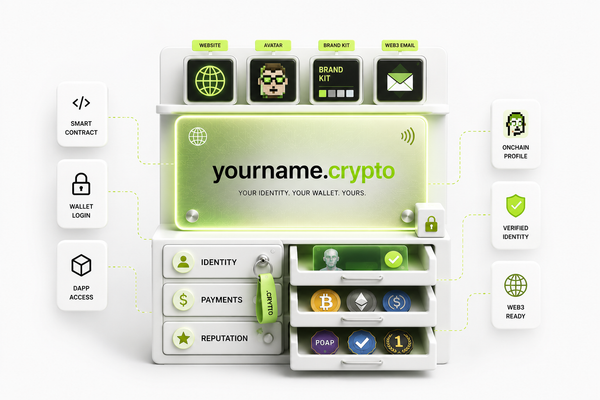
Everything You Need to Know Before Buying a.sol Domain
Solana Naming Service is the Solana program that lets users generate a readable domain name that may replace a public key.

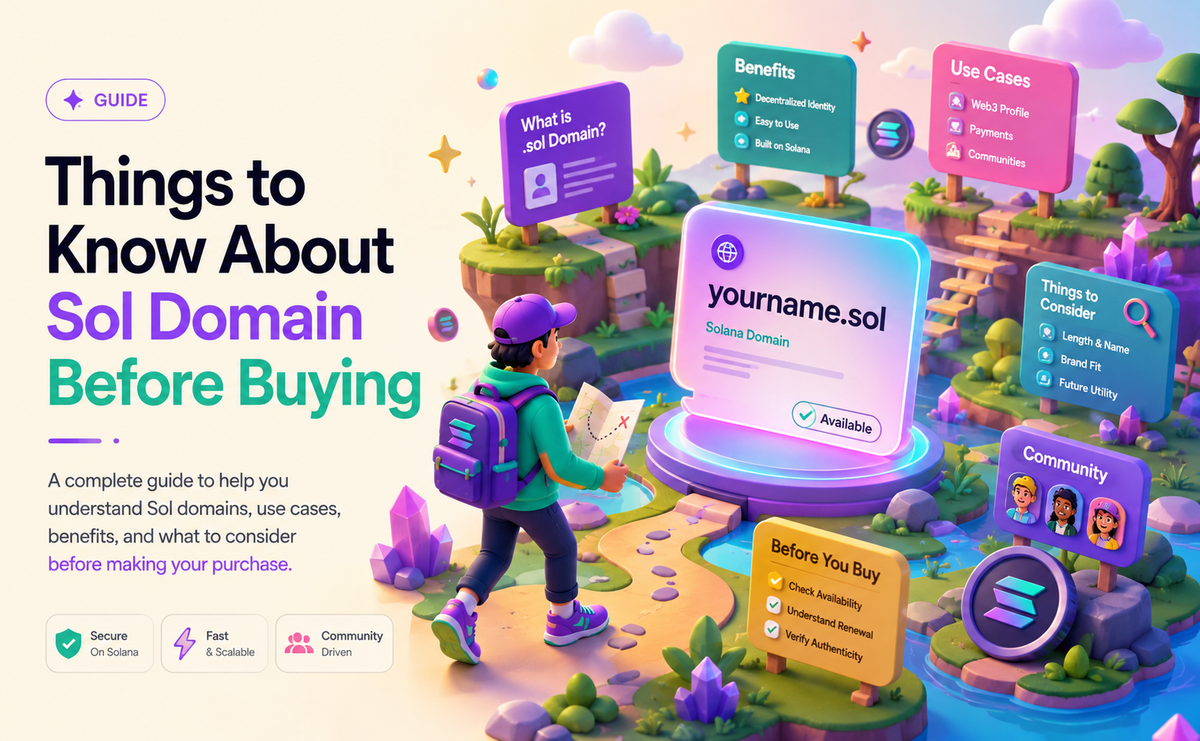
If you've spent any time in the Solana ecosystem, you've probably noticed the .sol domains popping up everywhere. Traders, developers, artists, and project founders are all claiming their corner of Solana's decentralized internet and for good reason.
But is a .sol domain actually worth it? What do you get out of it, how do you register one, and what should you watch out for before you hand over your USDC? This guide walks you through all of it the benefits, the registration process, the real challenges, and what the future looks like for Solana-based domains.
Let's start from the beginning.
What Is a .sol Domain, Exactly?
A .sol domain is a human-readable name that sits on top of your Solana wallet address. Think of it as a nickname for a string of characters that nobody could ever actually memorize.
Every Solana wallet has a public address: a 32-to-44 character string of random letters and numbers that you need every time you send or receive anything on the network. It works, but it's clunky, error-prone, and completely impersonal. A .sol domain replaces all of that with something clean and recognizable, like yourname.sol or yourbrand.sol.
The system behind this is called the Solana Name Service (SNS), built by a company called Bonfida and launched in June 2021. SNS is a Solana program that lets users register readable domain names that map directly to their public wallet keys. Once registered, your .sol domain works as a universal alias usable for receiving crypto payments, NFT transfers, smart contract interactions, and even for finding your token accounts on a Solana blockchain explorer.
Bonfida's broader vision extends beyond wallet addresses. The goal is to enable fully decentralized websites hosted on .sol domains a genuine corner of the decentralized web that no company or government can take down.
Why .sol Domains Make Sense: The Core Benefits
1. No More Copying and Pasting Wallet Addresses
This is the most immediate, practical benefit, and if you've ever sent crypto, you know exactly why it matters.
Wallet addresses are long, ugly, and terrifying to work with. One wrong character and your funds go somewhere they shouldn't, with no way to recover them. The anxiety of triple-checking a 44-character string before hitting send is a very real part of the crypto user experience, and it's one of the biggest barriers to mainstream adoption.
A .sol domain eliminates that problem entirely. Instead of sharing a string like 7xKXtg2CW87d97TXJSDpbD5jBkheTqA83TZRuJosgAsU, you share yourname.sol. Your business partners, friends, and customers can send you transactions instantly, without second-guessing every character. It's a small change that makes a meaningful difference in day-to-day usability.
2. Solana Is Genuinely Fast
Speed matters in crypto, and Solana is at the top of the leaderboard. The network can process roughly 50,000 transactions per second a figure that puts Ethereum's current 15-to-45 TPS firmly in the rearview mirror. For context, Visa claims to process around 24,000 TPS, which means Solana is already operating at a scale that could realistically compete with major payment networks.
That speed isn't just a bragging point. It translates directly into the user experience of everything built on Solana including .sol domains. Registrations process quickly, transfers happen fast, and the infrastructure supporting your domain is built on one of the highest-performing blockchains in existence.
3. It's Affordable to Register
Getting a .sol domain costs 20 USDC plus a small gas fee paid in SOL (roughly 0.008 SOL for a standard 1kB domain). For a permanent, blockchain-based domain name, that's genuinely inexpensive. There are no annual renewal fees and no expiration dates once you register a .sol domain, it's yours indefinitely.
Compare that to traditional domain registration, where you're paying renewal fees every year and a registrar can under the right circumstances revoke your domain entirely. With a .sol domain, ownership is on-chain and permanent.
4. Censorship Resistance That Actually Means Something
Traditional websites are vulnerable in ways that most people don't think about until something goes wrong. A company can pull your domain. A government can order a registrar to take your site offline. A payment processor can cut off your ability to receive funds. The centralized infrastructure of Web2 creates multiple choke points that can be used to silence or shut down anyone operating within it.
.sol domains don't work that way. They're stored on Solana's decentralized network, which means no single entity no company, no government, no platform controls them. Your domain exists as long as the Solana blockchain exists, and there's no centralized registrar to pressure into compliance.
For individuals and businesses operating in politically sensitive spaces, or anyone who simply values the principle of owning their online presence without strings attached, this is a meaningful advantage.
5. Plenty of Good Names Are Still Available
The .com gold rush happened decades ago. Almost every short, memorable, meaningful .com domain has been taken often sitting in the portfolio of a domain squatter waiting for the right offer. The same is increasingly true for .net, .org, and most other established extensions.
.sol is still relatively young. While the shortest and most generic names are being claimed quickly, there's still a wide range of unique, brandable, and relevant .sol domains available for registration. Getting in now, before the ecosystem fully matures, gives you access to names that might be significantly harder and more expensive to acquire in a few years.
How to Register a .sol Domain: Step by Step
The process is straightforward, even if you haven't done anything like this before. Here's exactly how it works:
Step 1: Go to the Bonfida naming service. Head to naming.bonfida.org or search "Solana Name Service" in your browser. This is the official platform for .sol domain registration.
Step 2: Connect your Solana wallet. Click "Connect Wallet" in the upper right corner. The site will automatically detect compatible wallets. Enter your password to allow SNS to communicate with your wallet.
Step 3: Search for your domain. Use the search bar to check whether the domain you want is available. If it's taken, you have two options: buy it directly from the current owner if they've listed it for sale, or submit an offer and wait for their response. The offer route takes longer, but it opens up the possibility of acquiring any registered domain even ones not actively listed.
Step 4: Add it to your cart. Once you find an available domain you want, click "Add to Cart." You can add multiple domains in a single session since one wallet can hold unlimited .sol domains.
Step 5: Choose your storage size. Before checking out, you'll see a storage option 1kB is the default, and it's sufficient for most users. If you have advanced use cases in mind, like hosting a website via IPFS, you can upgrade to 10kB. This decision is permanent, so think it through before finalizing. More storage means a slightly higher registration fee and potentially some future rent costs.
Step 6: Complete the purchase. Review your order, select how you want to pay (USDC is the default, but other tokens are increasingly supported), and click "Complete Purchase." Your wallet will prompt you to confirm the transaction.
Once the transaction goes through, the domain is yours. You can verify ownership on the Bonfida site or by looking up your wallet on Solscan and navigating to the "Domains" tab.
The Challenges Worth Knowing About
It would be easy to make .sol domains sound like a no brainer and for many users, they are. But there are real limitations and risks that any honest assessment has to include.
Adoption is still limited. SNS launched in 2021, which makes it relatively young in blockchain terms. Integration with Solana dApps and services is growing but not yet universal. Some wallets don't support .sol domains natively, which can create friction for less technical users. As standards develop, compatibility will improve but right now, you may encounter situations where your .sol domain doesn't work as seamlessly as you'd hope.
There's a technical learning curve. Setting up and managing a .sol domain requires a basic level of comfort with crypto wallets, blockchain transactions, and the Solana Domain Name. For users who are brand new to all of this, the onboarding experience can feel steep. Better educational resources and more intuitive interfaces are coming, but they're not fully there yet.
Domain squatting and scams are real. Wherever there's a new digital asset with speculative value, bad actors follow. .sol domains are no exception. Some registrants are buying up names with no intention of using them just holding them to sell at a markup. Others are operating outright scams. Do your homework, buy only through the official Bonfida platform, and be skeptical of unsolicited offers for domains.
Interoperability is limited for now. .sol domains live on Solana. They don't seamlessly communicate with domains on Ethereum, Polygon, or other blockchains. For users building multi-chain projects or hoping for a unified Web3 identity across networks, this is a genuine limitation. Cross-chain domain interoperability is an active area of development across the industry, but it's not solved yet.
You're dependent on Solana's performance. If the Solana network experiences congestion, outages, or performance issues and it has, historically your .sol domain is affected. Registration transactions can slow down, fees can spike temporarily, and in rare cases, maintenance windows can briefly limit accessibility. Solana has improved significantly in stability, but it's worth knowing that your domain's functionality is tied to the network's health.
Competition from other domain systems. .sol isn't the only blockchain domain game in town. Ethereum Name Service (.eth), Unstoppable Domains, Handshake, and other platforms are all competing for the same market. Each has its own trade-offs in cost, compatibility, and ecosystem depth. If Solana fails to maintain its momentum as a developer and user platform, .sol domains could lose ground to more interoperable alternatives.
What's Next for .sol Domains?
The future of .sol domains is directly tied to the future of Solana which makes it worth paying attention to where the network is headed.
Solana has already demonstrated that it can attract serious developer talent, major NFT projects, and institutional backing. Its speed and cost advantages over Ethereum remain significant. As more applications, games, DeFi platforms, and creator tools build on Solana, the value of having a permanent, readable identity in that ecosystem grows alongside them.
Cross-chain interoperability is the biggest open question. If .sol domains can eventually interact seamlessly with domains and identities on other blockchains, their utility expands dramatically. If Solana remains largely siloed, more flexible alternatives may capture users who are building across multiple networks.
The development of decentralized websites hosted on .sol domains Bonfida's original broader vision is another area to watch. A genuinely censorship-resistant web, accessible through .sol domains, would be a meaningful shift in how decentralized content is published and accessed. That future is still early-stage, but the infrastructure is being built.
Should You Buy a .sol Domain?
Here's the honest answer: it depends on what you're trying to accomplish.
If you're active in the Solana ecosystem trading, building, collecting NFTs, or running a project a .sol domain is a low-cost, high-utility upgrade to your Web3 experience. The permanent ownership model, the censorship resistance, and the practical usability improvements make it a straightforward decision at $20.
If you're thinking about it purely as a speculative investment, the picture is less clear. Short, memorable .sol domains could appreciate significantly as the ecosystem grows but that growth isn't guaranteed, and the domain market has risks that any crypto investment carries.
If you're completely new to the Solana ecosystem, it might be worth getting comfortable with the basics of crypto wallets and transactions before diving into domain registration. The process isn't complicated, but it does require a minimum level of technical confidence.
Whatever you decide, the key is to go in with clear eyes. Understand what you're buying, understand the risks, and make a decision based on your actual needs not hype.
The decentralized web has a long way to go before it's mainstream. But the infrastructure being built right now, including .sol domains, .eth domains, .polygon domains, .dao domains, and Endless Domains emerging across different blockchain ecosystems, is laying the foundation for what comes next.